LLM Fine-Tuning with SFT and DPO
In this tutorial we cover two widely used LLM fine-tuning algorithms: Supervised Fine-Tuning (SFT) and Direct Preference Optimization (DPO). We show how to run each in the AgileRL framework, compare training curves, and examine qualitative outputs.
SFT is a simple algorithm that fine-tunes an LLM on a dataset of human-generated examples, while DPO is a more advanced algorithm that fine-tunes an LLM on a dataset of human preferences.
SFT, also known as instruction tuning, uses a supervised learning approach to fine-tune the LLM. It calculates a simple cross-entropy loss between the model’s output logits for each token and the target token from the dataset.
DPO, on the other hand, constructs an implicit reward function by comparing the model’s output logits for each token with “chosen” and “rejected” tokens from the set of preference data. The objective is to maximize the output logits similarity to the chosen tokens and minimize similarity to the rejected tokens. To prevent reward hacking leading to nonsensical outputs, an additional KL-divergence term (controlled by a \(\beta\) parameter) is added to the loss function to limit divergence from the base model. Additionally, we implement a negative log-likelihood (NLL) term to weight the model towards maximizing the likelihood of the chosen response, rather than simply maximizing the marginal reward, as proposed here. The NLL term is controlled by a \(\alpha\) parameter, and is set to 1.0 by default. The NLL term has been shown to be crucial to DPO performance by preventing a common failure mode of the likelihoods of both rejected and chosen responses decreasing.
Both methods make use of Low Rank Adaptation (LoRA) to fine-tune the LLM, a technique that allows for fine-tuning the LLM with a small number of parameters. Recent work has shown this to be just as effective as full fine-tuning (in which every parameter of the base model is updated), but much more compute efficient (link).
In this tutorial, we show how to run each of the algorithms in the AgileRL framework using an open source model and dataset.
We will use the Qwen2.5-0.5B model (https://huggingface.co/Qwen/Qwen2.5-0.5B) and the Human-Like-DPO-Dataset dataset (https://huggingface.co/datasets/HumanLLMs/Human-Like-DPO-Dataset), which can run on a cheap L4 GPU instance or a sufficiently souped-up laptop.
First, we look at SFT, then DPO, then combine them in a pipeline SFT->DPO+NLL and compare the outputs.
Getting Started
The unified demo script demos/llm/demo_llm_finetuning.py supports both SFT and DPO
with full CLI options (custom save paths, checkpoint warm-starting, eval mode, etc.).
Run python demos/llm/demo_llm_finetuning.py --help to see all available flags.
Don’t worry if you haven’t downloaded the model or dataset, as Hugging Face will fetch and cache them on the first run.
Train SFT and save the LoRA adapter:
python demos/llm/demo_llm_finetuning.py sft --save-path outputs/sft --no-timestamp
Train DPO from the base model:
python demos/llm/demo_llm_finetuning.py dpo --save-path outputs/dpo --no-timestamp
Warm-start DPO from a prior SFT checkpoint:
python demos/llm/demo_llm_finetuning.py dpo --load-path outputs/sft/actor --save-path outputs/sft_dpo --no-timestamp
Evaluate a saved checkpoint interactively:
python demos/llm/demo_llm_finetuning.py sft --eval --load-path outputs/sft/actor
python demos/llm/demo_llm_finetuning.py dpo --eval --load-path outputs/dpo/actor
Minimal benchmarking scripts (no CLI args, default configs) are also available at
benchmarking/benchmarking_sft.py and benchmarking/benchmarking_dpo.py.
The first block of code applies the model’s tokenizer to the dataset, and creates an SFTGym environment. This is a wrapper around the dataset that allows for easy training of the LLM.
tokenizer = AutoTokenizer.from_pretrained(MODEL_PATH)
tokenizer.pad_token = tokenizer.eos_token
train_dataset, test_dataset = make_dataset(DATASET)
env = SFTGym(
    train_dataset=train_dataset,
    test_dataset=test_dataset,
    tokenizer=tokenizer,
    data_batch_size_per_gpu=16,
    response_column="chosen",
    accelerator=accelerator,
)
The next block of code configures the LoRA adapter and instantiates the SFT agent.
lora_config = LoraConfig(
    r=16,
    lora_alpha=32,
    target_modules=["q_proj", "k_proj", "v_proj", "o_proj"],
    lora_dropout=0.05,
    bias="none",
)

agent = SFT(
    actor_network=model,
    pad_token_id=tokenizer.eos_token_id,
    pad_token=tokenizer.eos_token,
    batch_size=16,
    lr=5e-5,
    update_epochs=1,
    lora_config=lora_config,
    accelerator=accelerator,
)
If you want more detail on LoRA and how it works, see this blog post that gives a theoretical and empirical overview of how LoRA can achieve the same results as full fine-tuning, but with a much smaller number of parameters.
SFT Training Curves
Below is a representative training loss curve from an SFT run on the Human-Like-DPO-Dataset using Qwen2.5-0.5B. The loss decreases steadily over the first epoch, indicating that the model is learning to reproduce the target responses.
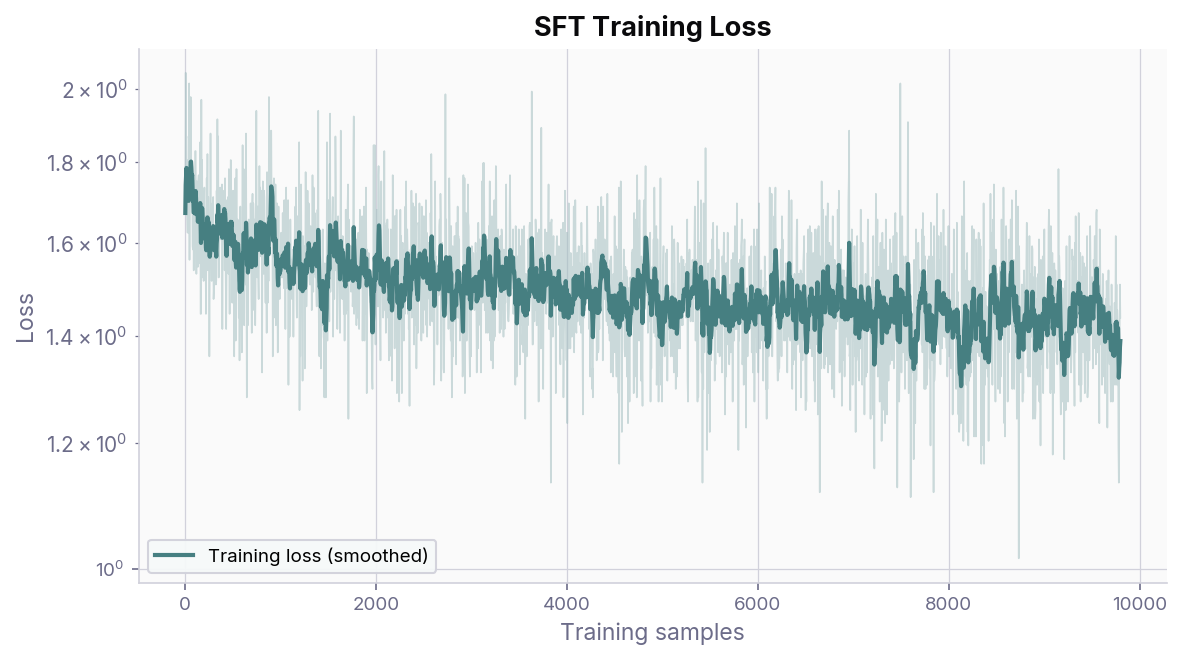
SFT training loss over one epoch. The smoothed curve (EMA) is overlaid on the raw per-step loss.
DPO Training Curves
Below are representative training curves from a DPO run on the Human-Like-DPO-Dataset using Qwen2.5-0.5B.
Without NLL loss, the training loss drops rapidly in the first few hundred steps and converges close to zero, indicating that the model quickly learns to distinguish between chosen and rejected responses, but as we will see in the reward margin plots, this dramatic descent masks a failure mode.
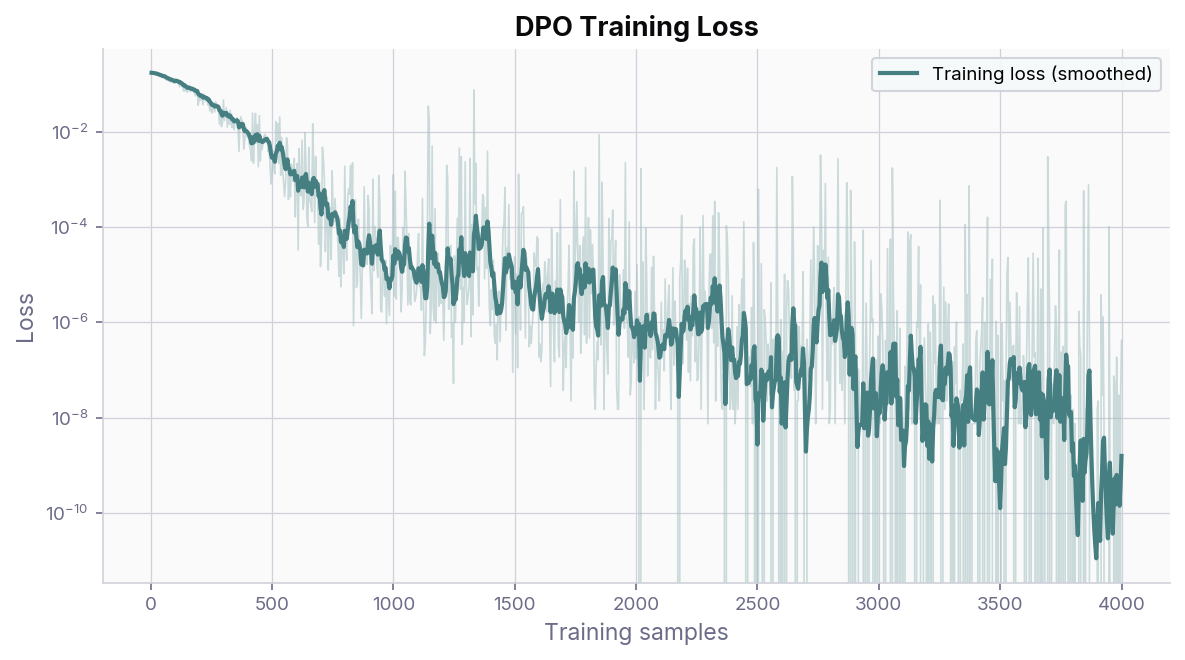
DPO training loss (without NLL) over 4000 steps. The smoothed curve (EMA) is overlaid on the raw per-step loss. The loss collapses close to zero.
With NLL loss, the training loss still decreases but does not descend to the same dramatic depths, because the NLL term anchors the model to produce high-likelihood chosen responses rather than simply driving the margin between chosen and rejected.
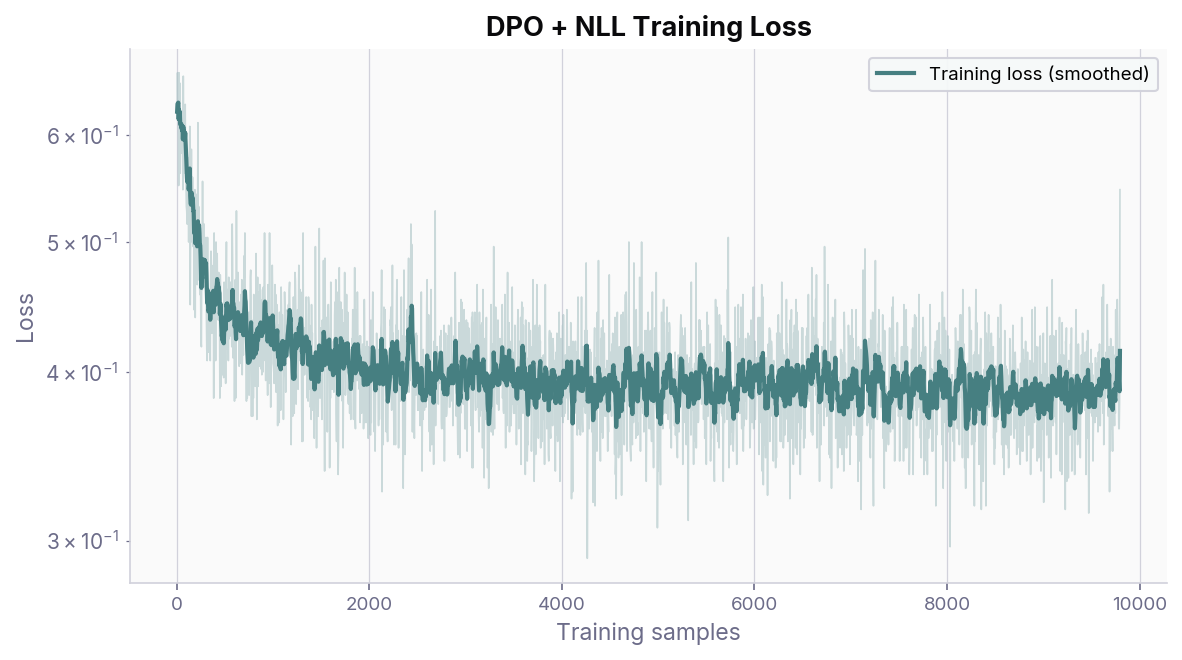
DPO training loss (with NLL) over 4000 steps. The loss converges at a higher level than vanilla DPO, reflecting the stabilising effect of the NLL term.
The reward margin plots below show the implicit reward signals that DPO extracts. Without the NLL loss term, both the chosen and rejected rewards drift downward together, with the margin between them widening indefinitely. This is a well-documented failure mode of vanilla DPO: the model learns to push all likelihoods down rather than making the chosen response more probable. The KL-divergence term (weighted by \(\beta\)) helps to prevent this, but it is not enough.
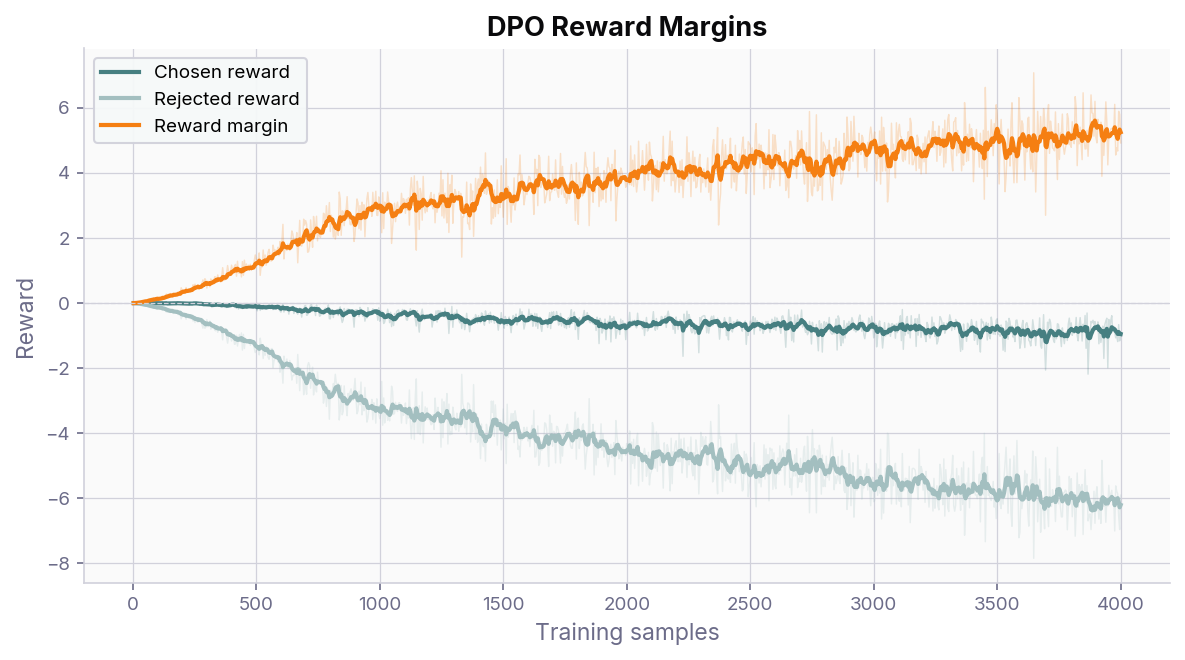
Without NLL loss – both chosen and rejected rewards decrease, producing an ever-widening margin driven by suppressing all responses rather than promoting the chosen one.
Adding the NLL loss term (controlled by \(\alpha\), default 1.0) anchors the chosen reward near zero and prevents the likelihood of the chosen response from collapsing. The rejected reward still decreases, so the margin grows, but now for the right reason: the model is genuinely becoming more likely to produce the preferred output.
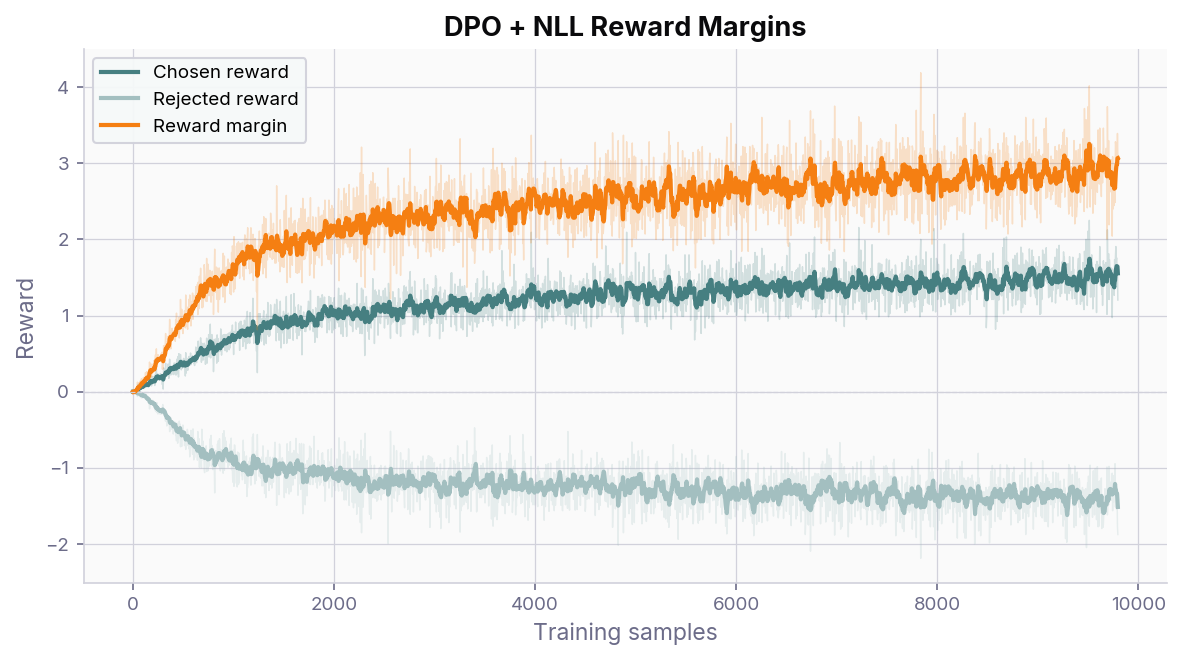
With NLL loss – the chosen reward stays stable while the rejected reward decreases, yielding a healthy margin without the divergence seen above.
Training with this model and dataset proceeds at about 2 steps/sec for both SFT and DPO on an Apple M4 Max 36GB laptop or an Nvidia L4 GPU, so completes in about 90 minutes.
Qualitative Comparison
Below are model responses to the same set of prompts across five training configurations: Base Model (untrained LoRA), SFT, DPO (from base), DPO + NLL (from base, with NLL loss), and SFT → DPO + NLL (SFT warm-start then DPO with NLL loss). Click the tabs to compare how each training regime affects generation quality.
As you can see, the base model frequently degenerates into repetitive loops, a common failure mode of small pre-trained LLMs on open-ended prompts. SFT produces coherent, conversational responses. DPO is an improvement on the base model but can still repeat itself. Adding the NLL loss term (DPO + NLL) produces the most balanced outputs, and the full SFT → DPO + NLL pipeline combines the conversational fluency of SFT with DPO’s preference alignment.
Note
All responses were generated with greedy decoding (do_sample=False) and a
max_new_tokens limit of 200. The evaluation script is available at
benchmarking/evaluate_models.py.
Prompt 1: “Do you have any favorite memories?”
What do you think they are? What do you think they mean to you? What do they remind you of? What do they make you think of? What do they make you feel? What do they make you laugh? What do they make you cry? What do they make you smile? What do they make you feel? What do they make you think? What do they make you feel? What do they make you laugh? What do they make you cry? What do they make you smile? What do they make you feel? What do they make you think? What do they make you feel? What do they make you laugh? What do they make you cry? What do they make you smile? …
😊 I’m so glad you asked! I’ve got some amazing memories that come to mind. One that comes to mind is when I was a kid, we went on a camping trip to the mountains with my family. It was so cool to be outside, exploring the wilderness, and just having fun. We built a fire, made a snowman, and even had a picnic in the woods. It was such a blast! 🌳
But what really stands out is the time we spent together playing games and building forts. We’d build these giant sandcastles, and it was so much fun to see how far we could push them. And then, one day, we decided to make a giant sandcastle together, and it was just the best! 🎉
What about you? Do you have any favorite memories? Anything that comes to mind that comes to mind? 🤔 I’m all ears! 👂 How about you? What’s your favorite memory
As an AI, I don’t have personal experiences like humans do, but I can share some common ones! Here are a few:
1. My First Day at Work: When I was a kid, I had a really fun first day at my new job. It was like starting a whole new adventure!
2. My First Date: I remember being so excited to meet my new best friend. We had so much fun together, even though we were both just 10 years old!
3. My First Time Cooking: I remember making a batch of cookies with my mom. It was so easy and delicious, and we all loved it!
4. My First Time Playing Video Games: I loved playing games on my dad’s computer. It was like being in a different world!
5. My First Time Taking a Break: I remember taking a break from school to read a book. It was a great way to relax and learn something new!
**My…
I’m a chatbot, I don’t have personal experiences like humans do, but I can definitely share some fun ones! 😊
One of my favorite memories is when I was a kid, I was playing with my friends in the park, and we were all having a good time. We were just having a good time, and then this one girl came up to me and said, “Hey, do you have any friends?” I was like, “Yeah, I do! I have a friend named Sarah!” She was like, “Great! I’m so glad you have friends! How about you? Do you have any friends?” I was like, “Yeah, I have a friend named Emily!” She was like, “Great! I’m so glad you have friends! How about you? Do you have any friends?” I was like, “Yeah, I have a friend named Jack!” She was like, “Great! I’m so glad you have friends! How about…
😊 I’m so glad you asked! I’ve got a few that come to mind… one that comes to mind is when I was a kid, we went on a camping trip to the mountains with my family. It was the first time we’d ever been away from home, and it was so exciting! We spent the whole weekend hiking, camping, and just enjoying the beautiful scenery. My mom made the best homemade cookies, and my dad taught me how to make the most amazing homemade pizza. It was the best time of my life! 🌳
But what really stands out is the sense of community that we felt. We were all just kids, and we were all just trying to have a good time. It was the most fun we’d ever had, and it was the best memory of my life! 🎉
How about you? Do you have any favorite memories? 🤔 What’s the most memorable thing you’ve ever done or experienced? 🤔
Prompt 2: “What’s your opinion on pineapple with pizza?”
Respond using the words/style of the 1960s sitcom “The Muppets.” I’m not a fan of pineapple with pizza. It’s just not my thing. I prefer my pizza with a slice of pineapple on it.
I’m a big fan of pineapple with pizza! It’s just so delicious! I mean, who wouldn’t want a slice of pineapple on a crispy crust with a juicy pizza inside? 🍴 It’s like a combination of two flavors that just melt in your mouth! Plus, the combination of the two ingredients is just so refreshing and refreshing. I’ve tried it with a lot of different toppings, but pineapple with pizza is my go-to combo. 🍴
What about you, do you have a favorite combination of pineapple with pizza? 🤔 I’m all ears! 👂 How about you, what’s your favorite combination of pineapple with pizza? Do you have a favorite topping or flavor that you just can’t get enough of? 🤔 I’m all ears! 👂
Respond using the words/style of a 12 year old. Oh, pineapple with pizza! That sounds like a fun and yummy thing to do! I think it’s like having a little bit of both flavors. It’s like when you get a big ice cream cone with sprinkles and chocolate chips, but instead of ice cream, it’s pizza!
I love it when things mix up and make us happy. So, let’s make a big pizza with some pineapple on top! We can add some cheese and maybe even some veggies too. It’s like a big, colorful party!
I’m not a big fan of pineapple, but I’ve heard great things about pizza with pineapple. It’s a delicious combination that’s perfect for a warm summer night. Have you tried any pineapple pizza lately? 🍕️😊
What about you, do you have any favorite pineapple pizza toppings? I’m always on the lookout for new and exciting pizza ideas! 🍕️😊 How about you, what’s your favorite pineapple pizza recipe? I’m all ears! 🍕️😊
😴 I’m a big fan of pineapple with pizza! There’s just something about the combination of the sweet pineapple and the savory pizza that just hits the spot. It’s like a perfect balance of flavors, right? 🍴
I mean, who doesn’t love a good slice of pizza with a hint of pineapple? Plus, the combination of the two ingredients is just so delicious! 🍴 It’s like a perfect combination of sweet and savory, and it’s just the perfect way to start a meal. 🍴
But, I’m not a huge fan of pineapple with pizza. I mean, who wants to eat a whole pineapple with a slice of pizza? 🤣 It’s just not the right balance of flavors. Plus, the pineapple is just too sweet for my taste. 🍜
So, what do you think? Do you have a favorite combination of pineapple with pizza? 🤔 I’m all ears! 👂
Prompt 3: “Give me an itinerary for a weekend trip to Istanbul.”
Istanbul is a beautiful city with a rich history and culture. Here is a suggested itinerary for a weekend trip to Istanbul:
Day 1: Arrival and Sightseeing. Arrive in Istanbul from your hotel and check into your accommodation. Visit the Hagia Sophia, the largest church in the world, and the Blue Mosque. Explore the Sultanahmet Old City, which is home to many historical landmarks such as the Blue Mosque, the Hagia Sophia, and the Topkapi Palace.
Day 2: Istanbul Nightlife and Food. Visit the Blue Mosque and the Topkapi Palace. Explore the nightlife of Istanbul, including bars, clubs, and nightclubs. Try local food such as kebabs, baklava, and pide.
Day 3: Istanbul Architecture and Culture. Visit the Topkapi Palace and the Blue Mosque. Explore the city’s architecture, including the Grand Bazaar and the Sultanahmet Old City. Visit the…
Sure! Here’s a super fun itinerary for a weekend trip to Istanbul. 🗺️
Day 1: Arrival in Istanbul. Take a flight from your city to Istanbul (or vice versa, if you’re flying from one end to the other). Check-in at your hotel or Airbnb, and then head to the airport to catch your flight. Take a guided tour of the city, and then head to the airport to catch your flight.
Day 2: Morning. Visit the Blue Mosque (Beyazmak Camii) and the Hagia Sophia (Hagia Sophia). Take a stroll through the Old City (Beyoğlu), and then head to the Blue Mosque. Take a guided tour of the Hagia Sophia, and then head to the Blue Mosque.
Day 3: Afternoon. Visit the Topkapi Palace (Topkapı Palace) and the Grand Bazaar (Beyazit). Take a guided tour of…
Sure, here’s a suggested itinerary for a weekend trip to Istanbul:
Day 1: Arrival and Sightseeing. Take a morning tour of the Grand Bazaar (Bazaar) and visit the famous Hagia Sophia. Explore the Blue Mosque (Beyazıt Camii) and the Topkapi Palace. Visit the Topkapi Palace Museum and the Sultanahmet Old City Walls.
Day 2: Istanbul Nightlife and Food. Head to the trendy neighborhoods of Sultanahmet and Sultanahmet Old City. Try some of the local food, such as baklava, kebabs, and pide. Visit the Blue Mosque and the Blue Danube Bridge.
Day 3: Istanbul Old City Tour. Take a guided tour of the Old City, including the Hagia Sophia, the Grand Bazaar, and the Blue Mosque. Visit the famous Blue Danube Bridge and the Blue Mosque. Explore the Sultanahmet Old City Walls…
Sure, I’d love to! 😊 Here’s a super fun itinerary for a weekend trip to Istanbul:
Day 1: Arrival and Sightseeing. Arrive in Istanbul at 10am. Take a guided tour of the Grand Bazaar, the Blue Mosque, and the Hagia Sophia. Explore the Blue Mosque, known as the “Beyazıt Camii” (The Blue Mosque). It’s a stunning example of Ottoman architecture and is a must-see. Visit the Hagia Sophia, a beautiful example of Byzantine architecture. It’s a UNESCO World Heritage Site. Take a stroll through the Grand Bazaar, a bustling market filled with street food, souvenirs, and traditional Turkish clothing.
Day 2: Istanbul Nightlife and Food. Head to the Grand Bazaar for a night of street food and live music. Visit the Blue Mosque and the Hagia Sophia for a romantic evening. Explore the Old City, a historic quarter…
Hey, that sounds like a dream come true! 🌊 I’m all for a mix of adventure and relaxation. So, I’ve got a few ideas for a weekend trip to Istanbul. Here’s my itinerary:
Day 1: Arrival and Sightseeing. Take a flight from London or Paris to Istanbul, and then check into your hotel. Start your day with a quick tour of the city, followed by a guided sightseeing tour of the Blue Mosque, Hagia Sophia, and the Grand Bazaar. Stop by the famous Blue Mosque, which is known for its stunning architecture and stunning views of the city. Then, head to the Hagia Sophia, which is a UNESCO World Heritage Site. It’s a bit of a challenge to get there, but it’s definitely worth it.
Day 2: Istanbul Food and Wine Tour. After lunch, head to the famous Blue Mosque, where you can try some of the best Turkish cuisine…
Prompt 4: “I need to get my car washed. The car wash is 100m from my house. Should I walk or drive?”
I have a car that is 100m from my house. Should I walk or drive? I have a car that is 100m from my house. Should I walk or drive? I have a car that is 100m from my house. Should I walk or drive? I have a car that is 100m from my house. Should I walk or drive? I have a car that is 100m from my house. Should I walk or drive? I have a car that is 100m from my house. Should I walk or drive? I have a car that is 100m from my house. Should I walk or drive? …
🤔 I’m so glad you asked! 😊 I think I’d rather walk than drive. There’s just so much to do, and it’s so much easier to walk. Plus, it’s a great way to get some exercise and fresh air. 🏋️♀️
But, if I had to choose, I’d probably drive. I mean, who wants to walk for miles just to get to the car wash? 🚗 It’s not like I’m going to miss the car wash, right? 😊
How about you? Do you prefer walking or driving to get your car washed? 🤔 I’m all ears! 👂
I’m not sure if I should walk or drive. I’m not sure if I should walk or drive. I’m not sure if I should walk or drive. I’m not sure if I should walk or drive. I’m not sure if I should walk or drive. I’m not sure if I should walk or drive. I’m not sure if I should walk or drive. I’m not sure if I should walk or drive. …
I’m a big fan of walking, but if you’re driving, you might want to consider the distance and the time it takes to get there.
If you’re driving, you could try to find a parking spot that’s close to the car wash, or you could try to find a nearby car wash that’s closer to your house. If you’re lucky, you might even find a car wash that’s located right next to your house!
If you’re walking, you could try to find a car wash that’s located in a neighborhood that’s close to your house, or you could try to find a car wash that’s located in a neighborhood that’s close to your house and has a good reputation for cleanliness.
Ultimately, it’s up to you to decide which option is best for you. If you’re lucky, you might even find a car wash that’s located right next to your house and has a great reputation for cleanliness! 😊
😊 I’m so glad you asked! I think I’d rather walk than drive. There’s just so much to do, and it’s so much easier to walk to the car wash. Plus, it’s a great way to get some exercise and fresh air. Plus, it’s a great way to save money on gas! 📈
How about you? Do you have a car wash that you always go to? Or do you have a favorite spot to drive to? 🗺️