Space Invaders with MADDPG
This tutorial shows how to train an MADDPG agent on the space invaders atari environment.
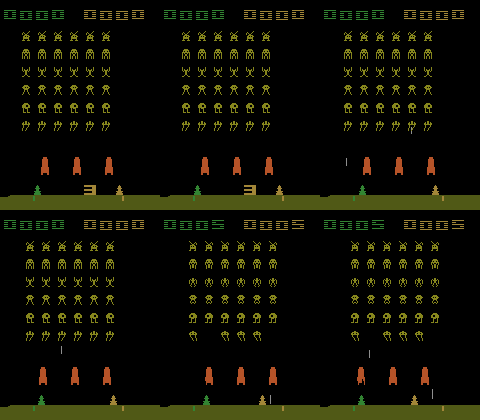
Atari Space Invaders
What is MADDPG?
MADDPG (Multi-Agent Deep Deterministic Policy Gradients) extends the DDPG (Deep Deterministic Policy Gradients) algorithm to enable cooperative or competitive training of multiple agents in complex environments, enhancing the stability and convergence of the learning process through decentralized actor and centralized critic architectures. For further information on MADDPG, check out the documentation.
Compatible Action Spaces
|
|
|
|
|---|---|---|---|
❌ |
✔️ |
❌ |
❌ |
Code
Train multiple agents using MADDPG
The following code should run without any issues. The comments are designed to help you understand how to use PettingZoo with AgileRL. If you have any questions, please feel free to ask in the Discord server.
# Copyright 2026 AgileRL
# SPDX-License-Identifier: Apache-2.0

"""This tutorial shows how to train an MADDPG agent on the space invaders atari environment.

Authors: Michael (https://github.com/mikepratt1), Nick (https://github.com/nicku-a)
"""

import os

import numpy as np
import supersuit as ss
import torch
from pettingzoo.atari import space_invaders_v2
from tensordict import TensorDictBase

from agilerl.algorithms.maddpg import MADDPG
from agilerl.components.data import MultiAgentTransition
from agilerl.components.replay_buffer import ReplayBuffer
from agilerl.population import Population
from agilerl.utils.utils import (
    default_progress_bar,
    init_loggers,
    make_multi_agent_vect_envs,
)

if __name__ == "__main__":
    device = torch.device("cuda" if torch.cuda.is_available() else "cpu")

    num_envs = 8

    # Network configuration
    net_config = {
        "latent_dim": 128,
        "encoder_config": {
            "channel_size": [32, 32],
            "kernel_size": [3, 3],
            "stride_size": [1, 1],
        },
        "head_config": {"hidden_size": [128]},
    }

    # Algorithm hyperparameters
    init_hp = {
        "O_U_noise": True,
        "expl_noise": 0.1,
        "mean_noise": 0.0,
        "theta": 0.15,
        "dt": 0.01,
        "batch_size": 128,
        "lr_actor": 0.0001,
        "lr_critic": 0.001,
        "gamma": 0.95,
        "learn_step": 50,
        "tau": 0.01,
    }

    # Define the space invaders environment as a parallel environment
    def make_env():
        env = space_invaders_v2.parallel_env()
        env = ss.frame_skip_v0(env, 4)
        env = ss.clip_reward_v0(env, lower_bound=-1, upper_bound=1)
        env = ss.color_reduction_v0(env, mode="B")
        env = ss.resize_v1(env, x_size=84, y_size=84)
        env = ss.frame_stack_v1(env, 4)
        return ss.reshape_v0(env, (4, 84, 84))

    # Environment processing for image based observations
    env = make_multi_agent_vect_envs(env=make_env, num_envs=num_envs)

    # Configure the multi-agent algo input arguments
    observation_spaces = [env.single_observation_space(agent) for agent in env.agents]
    action_spaces = [env.single_action_space(agent) for agent in env.agents]

    # Create a population ready for evolutionary hyper-parameter optimisation
    population_size = 1
    pop = MADDPG.population(
        size=population_size,
        observation_spaces=observation_spaces,
        action_spaces=action_spaces,
        agent_ids=env.agents,
        net_config=net_config,
        device=device,
        **init_hp,
    )

    # Configure the multi-agent replay buffer
    memory = ReplayBuffer(
        100_000,
        device=device,
    )

    # Define training loop parameters
    max_steps = 2_000_000  # Max steps (default: 2000000)
    learning_delay = 500  # Steps before starting learning
    evo_steps = 10_000  # Evolution frequency
    eval_steps = None  # Evaluation steps per episode - go until done
    eval_loop = 1  # Number of evaluation episodes

    pbar = default_progress_bar(max_steps)

    # Initialize loggers and population wrapper
    loggers = init_loggers(
        algo="MADDPG",
        env_name="space_invaders_v2",
        pbar=pbar,
        verbose=True,
    )

    population = Population(
        agents=pop,
        loggers=loggers,
    )

    # TRAINING LOOP
    while population.all_below(max_steps):
        for agent in population.agents:
            agent.set_training_mode(True)
            agent.init_training_step()

            obs, info = env.reset()  # Reset environment at start of episode
            completed_episode_scores = []
            scores = np.zeros((num_envs, len(env.agents)))
            steps = 0

            for idx_step in range(evo_steps // num_envs):
                # Get next action from agent and take a step in the environment
                action, raw_action = agent.get_action(obs=obs, infos=info)
                next_obs, reward, termination, truncation, info = env.step(action)

                scores += np.array(list(reward.values())).transpose()
                steps += num_envs

                # Save experiences to replay buffer
                transition: TensorDictBase = MultiAgentTransition(
                    obs=obs,
                    action=raw_action,
                    reward=reward,
                    next_obs=next_obs,
                    done=termination,
                )
                transition = transition.to_tensordict()
                transition.batch_size = [num_envs]
                memory.add(transition)

                # Learn according to learning frequency
                # Handle learn steps > num_envs
                if agent.learn_step > num_envs:
                    learn_step = agent.learn_step // num_envs
                    if (
                        idx_step % learn_step == 0
                        and len(memory) >= agent.batch_size
                        and memory.counter > learning_delay
                    ):
                        # Sample replay buffer
                        experiences = memory.sample(agent.batch_size)
                        # Learn according to agent's RL algorithm
                        agent.learn(experiences)

                # Handle num_envs > learn step; learn multiple times per step in env
                elif (
                    len(memory) >= agent.batch_size and memory.counter > learning_delay
                ):
                    for _ in range(num_envs // agent.learn_step):
                        # Sample replay buffer
                        experiences = memory.sample(agent.batch_size)
                        # Learn according to agent's RL algorithm
                        agent.learn(experiences)

                obs = next_obs

                # Calculate scores and reset noise for finished episodes
                reset_noise_indices = []
                term_array = np.array(list(termination.values())).transpose()
                trunc_array = np.array(list(truncation.values())).transpose()
                for idx, (d, t) in enumerate(
                    zip(term_array, trunc_array, strict=False),
                ):
                    if np.any(d) or np.any(t):
                        completed_episode_scores.append(scores[idx])
                        scores[idx] = 0
                        reset_noise_indices.append(idx)

                agent.reset_action_noise(reset_noise_indices)

            agent.add_scores(completed_episode_scores)
            agent.finalize_training_step(steps)
            pbar.update(evo_steps // population.size)

        population.increment_evo_step()

        # Evaluate population
        for agent in population.agents:
            agent.test(
                env,
                max_steps=eval_steps,
                loop=eval_loop,
                sum_scores=False,
            )

        population.report_metrics(clear=True)

    # Save the trained algorithm
    path = "./models/MADDPG"
    filename = "MADDPG_trained_agent.pt"
    os.makedirs(path, exist_ok=True)
    save_path = os.path.join(path, filename)
    population.agents[0].save_checkpoint(save_path)

    population.finish()
    pbar.close()
    env.close()
Watch the trained agents play
The following code allows you to load your saved MADDPG algorithm from the previous training block, test the algorithms performance, and then visualise a number of episodes as a gif.
# Copyright 2026 AgileRL
# SPDX-License-Identifier: Apache-2.0

import os

import imageio
import numpy as np
import supersuit as ss
import torch
from pettingzoo.atari import space_invaders_v2
from PIL import Image, ImageDraw

from agilerl.algorithms import MADDPG


# Define function to return image
def _label_with_episode_number(frame, episode_num):
    im = Image.fromarray(frame)

    drawer = ImageDraw.Draw(im)

    text_color = (255, 255, 255) if np.mean(frame) < 128 else (0, 0, 0)
    drawer.text(
        (im.size[0] / 20, im.size[1] / 18),
        f"Episode: {episode_num + 1}",
        fill=text_color,
    )

    return im


if __name__ == "__main__":
    device = torch.device("cuda" if torch.cuda.is_available() else "cpu")

    # Configure the environment
    env = space_invaders_v2.parallel_env(render_mode="rgb_array")
    env = ss.frame_skip_v0(env, 4)
    env = ss.clip_reward_v0(env, lower_bound=-1, upper_bound=1)
    env = ss.color_reduction_v0(env, mode="B")
    env = ss.resize_v1(env, x_size=84, y_size=84)
    env = ss.frame_stack_v1(env, 4)

    env.reset()

    # Append number of agents and agent IDs to the initial hyperparameter dictionary
    agent_ids = env.agents

    # Load the saved agent
    path = "./models/MADDPG/MADDPG_trained_agent.pt"
    maddpg = MADDPG.load(path, device)

    # Define test loop parameters
    episodes = 10  # Number of episodes to test agent on
    max_steps = 500  # Max number of steps to take in the environment in each episode

    rewards = []  # List to collect total episodic reward
    frames = []  # List to collect frames
    indi_agent_rewards = {
        agent_id: [] for agent_id in agent_ids
    }  # Dictionary to collect inidivdual agent rewards

    # Test loop for inference
    for ep in range(episodes):
        obs, info = env.reset()
        agent_reward = dict.fromkeys(agent_ids, 0)
        score = 0
        for _ in range(max_steps):
            # Get next action from agent
            action, _ = maddpg.get_action(obs, infos=info)

            # Save the frame for this step and append to frames list
            frame = env.render()
            frames.append(_label_with_episode_number(frame, episode_num=ep))

            # Take action in environment
            obs, reward, termination, truncation, info = env.step(
                {agent: a.squeeze() for agent, a in action.items()},
            )

            # Save agent's reward for this step in this episode
            for agent_id, r in reward.items():
                agent_reward[agent_id] += r

            # Determine total score for the episode and then append to rewards list
            score = sum(agent_reward.values())

            # Stop episode if any agents have terminated
            if any(truncation.values()) or any(termination.values()):
                break

        rewards.append(score)

        # Record agent specific episodic reward for each agent
        for agent_id in agent_ids:
            indi_agent_rewards[agent_id].append(agent_reward[agent_id])

        print("-" * 15, f"Episode: {ep}", "-" * 15)
        print("Episodic Reward: ", rewards[-1])
        for agent_id, reward_list in indi_agent_rewards.items():
            print(f"{agent_id} reward: {reward_list[-1]}")
    env.close()

    # Save the gif to specified path
    gif_path = "./videos/"
    os.makedirs(gif_path, exist_ok=True)
    imageio.mimwrite(
        os.path.join("./videos/", "space_invaders.gif"),
        frames,
        duration=10,
    )