PenDigits with NeuralTS
In this tutorial, we will be training a NeuralTS agent to solve the PenDigits dataset, converted into a bandit environment. We will also use evolutionary hyperparameter optimization on a population of agents.
To complete the PenDigits environment, the agent must learn to select the best arm, or action, to take in a given context, or state.
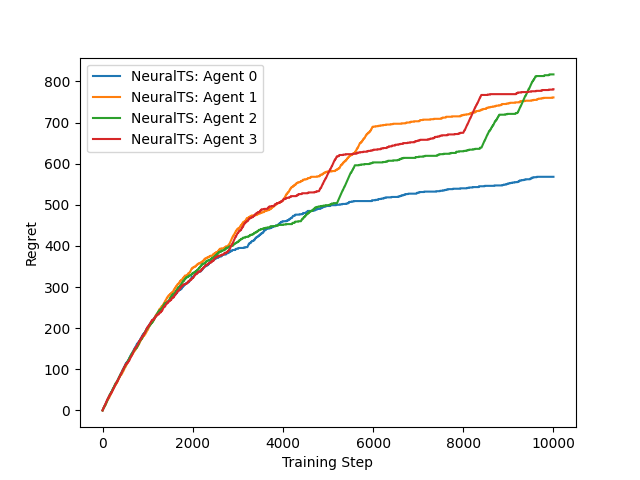
Figure 1: Cumulative regret from training on the PenDigits dataset¶ |
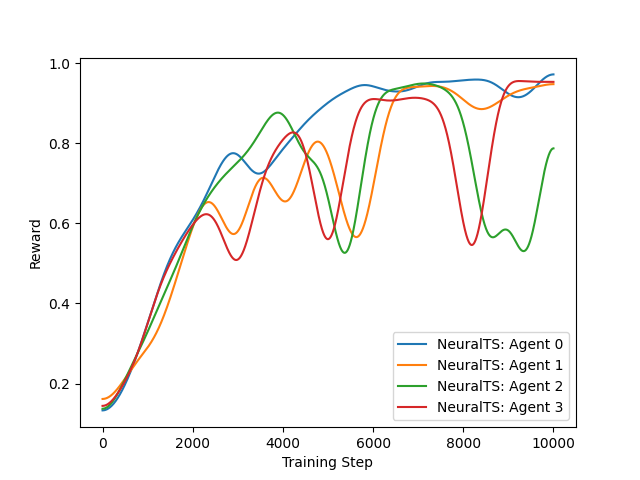
Figure 2: Reward from training on the PenDigits dataset¶ |
NeuralTS (Neural Contextual Bandits with Thompson Sampling) adapts deep neural networks for both exploration and exploitation by using a posterior distribution of the reward with a neural network approximator as its mean, and neural tangent features as its variance.
For this tutorial, we will use the labelled PenDigits dataset from the UCI Machine Learning Repository.
These datasets can easily be imported and used for training with the Python package ucimlrepo, and to choose from the hundreds of
available datasets it is as simple as changing the id parameter used by fetch_uci_repo.
We can convert these labelled datasets into a bandit learning environment easily by using the agilerl.wrappers.learning.BanditEnv class.
# Copyright 2026 AgileRL
# SPDX-License-Identifier: Apache-2.0

"""This tutorial shows how to train an NeuralTS agent on the PenDigits dataset with evolutionary HPO.

Authors: Nick (https://github.com/nicku-a)
"""

import matplotlib.pyplot as plt
import numpy as np
import torch
from gymnasium import spaces
from tensordict import TensorDict

from tutorials.utils import require_package

with require_package():
    from scipy.ndimage import gaussian_filter1d
    from ucimlrepo import fetch_ucirepo

from agilerl.algorithms import NeuralTS
from agilerl.algorithms.core.registry import HyperparameterConfig, RLParameter
from agilerl.components.replay_buffer import ReplayBuffer
from agilerl.hpo.mutation import Mutations
from agilerl.hpo.tournament import TournamentSelection
from agilerl.utils.utils import default_progress_bar
from agilerl.wrappers.learning import BanditEnv

if __name__ == "__main__":
    device = torch.device("cuda" if torch.cuda.is_available() else "cpu")

    # Network configuration
    net_config = {
        "latent_dim": 64,
        "encoder_config": {"hidden_size": [64]},
        "head_config": {"hidden_size": [64]},
    }

    # Algorithm hyperparameters
    init_hp = {
        "batch_size": 64,
        "lr": 0.001,
        "gamma": 1.0,
        "lamb": 1.0,
        "reg": 0.0625,
        "learn_step": 2,
    }

    population_size = 4

    # Fetch data  https://archive.ics.uci.edu/
    pendigits = fetch_ucirepo(id=81)
    features = pendigits.data.features
    targets = pendigits.data.targets

    env = BanditEnv(features, targets)  # Create environment
    context_dim = env.context_dim
    action_dim = env.arms

    # Mutation config for RL hyperparameters
    hp_config = HyperparameterConfig(
        lr=RLParameter(min=6.25e-5, max=1e-2),
        batch_size=RLParameter(min=8, max=512, dtype=int),
        learn_step=RLParameter(
            min=1,
            max=10,
            dtype=int,
            grow_factor=1.5,
            shrink_factor=0.75,
        ),
    )

    # Define observation and action spaces from dataset
    observation_space = spaces.Box(
        low=features.values.min(),
        high=features.values.max(),
        shape=context_dim,
    )
    action_space = spaces.Discrete(action_dim)

    # Create population of agents
    pop = NeuralTS.population(
        size=population_size,
        observation_space=observation_space,
        action_space=action_space,
        net_config=net_config,
        hp_config=hp_config,
        device=device,
        **init_hp,
    )

    memory = ReplayBuffer(
        max_size=10000,  # Max replay buffer size
        device=device,
    )

    tournament = TournamentSelection(
        tournament_size=2,  # Tournament selection size
        elitism=True,  # Elitism in tournament selection
        population_size=population_size,  # Population size
    )

    mutations = Mutations(
        no_mutation=0.4,  # No mutation
        architecture=0.2,  # Architecture mutation
        new_layer_prob=0.2,  # New layer mutation
        parameters=0.2,  # Network parameters mutation
        activation=0.2,  # Activation layer mutation
        rl_hp=0.2,  # Learning HP mutation
        mutation_sd=0.1,  # Mutation strength
        mutate_elite=False,  # Mutate best agent in population  # Network architecture
        rand_seed=1,  # Random seed
        device=device,
    )

    max_steps = 2500  # Max steps per episode
    episode_steps = 500  # Steps in episode
    evo_steps = 1000  # Evolution frequency
    eval_steps = 500  # Evaluation steps per episode
    eval_loop = 1  # Number of evaluation episodes
    evo_count = 0

    regret = [[0] for _ in pop]
    score = [[0] for _ in pop]
    total_steps = 0

    # TRAINING LOOP
    print("Training...")
    pbar = default_progress_bar(max_steps)
    while np.less([agent.steps for agent in pop], max_steps).all():
        for i, agent in enumerate(pop):  # Loop through population
            context = env.reset()  # Reset environment at start of episode
            for _ in range(episode_steps):
                # Get next action from agent
                action = agent.get_action(context)
                next_context, reward = env.step(action)  # Act in environment

                transition = TensorDict(
                    {
                        "obs": context[action],
                        "reward": reward,
                    },
                ).float()
                transition = transition.unsqueeze(0)
                transition.batch_size = [1]

                # Save experience to replay buffer
                memory.add(transition)

                # Learn according to learning frequency
                if len(memory) >= agent.batch_size:
                    for _ in range(agent.learn_step):
                        # Sample replay buffer
                        # Learn according to agent's RL algorithm
                        experiences = memory.sample(agent.batch_size)
                        agent.learn(experiences)

                context = next_context
                score[i].append(reward)
                regret[i].append(regret[i][-1] + 1 - reward)

            total_steps += episode_steps
            agent.steps += episode_steps

        pbar.update(episode_steps)

        fitnesses = [
            agent.test(
                env,
                max_steps=eval_steps,
                loop=eval_loop,
            )
            for agent in pop
        ]

        pbar.write(
            f"--- Global steps {total_steps} ---\n"
            f"Steps {[agent.steps for agent in pop]}\n"
            f"Regret: {[regret[i][-1] for i in range(len(pop))]}\n"
            f"Fitnesses: {[f'{fitness:.2f}' for fitness in fitnesses]}"
            f"Mutations: {[agent.mut for agent in pop]}",
        )

        if pop[0].steps // evo_steps > evo_count:
            # Tournament selection and population mutation
            elite, pop, _ = tournament.select(pop)
            pop = mutations.mutation(pop)
            evo_count += 1

    # Plot the results
    plt.figure()
    for i, agent_regret in enumerate(regret):
        plt.plot(
            np.linspace(0, total_steps, len(agent_regret)),
            agent_regret,
            label=f"NeuralTS: Agent {i}",
        )
    plt.xlabel("Training Step")
    plt.ylabel("Regret")
    plt.legend()
    plt.savefig("NeuralTS-PenDigits-regret.png")

    plt.figure()
    for i, agent_score in enumerate(score):
        smoothed_score = gaussian_filter1d(agent_score, sigma=80)
        plt.plot(
            np.linspace(0, total_steps, len(smoothed_score)),
            smoothed_score,
            label=f"NeuralTS: Agent {i}",
        )
    plt.xlabel("Training Step")
    plt.ylabel("Reward")
    plt.legend()
    plt.savefig("NeuralTS-PenDigits-reward.png")